How to Survive a Garden Gnome Attack
by Chuck Sambuchino
104 pages
Copyright 2010
Published by Ten Speed Press
I always wondered why my garden gnome statue keeps ending up on its face or even a foot or two away from where I last placed it. Now I know.
The darned thing wants to get me!
This cute little book would make a great gift for gardeners, yard statue addicts or somebody who just needs a clean giggle. I thought it was amusing and while I did not break out in loud guffaws I did smile a time or two.
The book is broken into several sections, including how to assess your risk, how to protect yourself (a moat seems like a lot of trouble . . .), how to defend your home, and how to apply what you've learned from the book.
The text is accompanied by pictures of garden gnomes spying on you, attempting to dig under your house . . . you get the idea. The photos are neat and, for me, the best part of the book.
This is a work which does not take itself very seriously. You might give it to your mother-in-law or an aunt or somebody like that if you're out of ideas, or use it for a stocking stuffer.
The hardcover book sells for $14.99; Amazon has it for $10.19.
*Note: the publisher contacted me and sent me a copy of this book. They did not ask me to review it on my blog in exchange for the book but I thought it was cute and would make a good gift, so here's a review of it.*

Monday, November 15, 2010


Sunday, November 14, 2010
The Squirrel and the Bench
A while back my husband left his "shooting bench" in the backyard. (A shooting bench is what he uses to site in his rifles so that they hit their target.) For some reason, this fascinated one of the squirrels in the backyard.
Friday, November 12, 2010
Autumn Colors


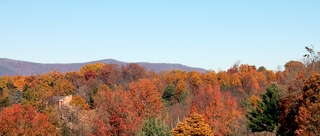
The Autumn colors for 2010 have finally reached the farm. For some reason I always think they should be here much earlier; they seem to come later and later instead.
The colors have not been as vibrant as they sometimes are but they have been lovely all the same.
I love these mountains.
Thursday, November 11, 2010
Thursday Thirteen
On Facebook my friend Becky, who writes Peevish Pen, had a list of influential authors "who will always stick with you" listed in a note. I thought it would make a great Thursday Thirteen! These are not necessarily in order of importance but I did find it interesting to see who came tumbling out for the list first, for they are listed in that order. Although I have read many of the classics, the names of those authors did not present themselves to me with any immediacy.
1. Carolyn Keene. Who? Why, the author of the Nancy Drew books! Mildred Benson wrote the first 23 of the first 25 books in the series, and then the name was taken over by ghost writers who cranked out mysteries that starred the motherless female detective and her friends George and Bess. At one time one my life's goals was to own every Nancy Drew book, but I only collected 25. The writing lessons I learned from these books included how to create empathy with a character and how to keep a plot moving forward.
2. Laura Ingalls Wilder. The author of the Little House series of books taught me how to use detail to "paint" a story and bring a time period to life. The history settings in these books allowed me to see that some things should be remembered.
3. L. M. Montgomery penned the Anne of Green Gables series. These adventures feature a young orphaned girl who is raised by a stern woman who grows to love her cheeky charge. I found the first book online in its entirety here!
4. Victoria Holt. I read my first Gothic romance when I was nine years old (far too young, but they were in the drawer in the babysitter's hallway desk - who could resist?). It was called The Secret Woman and it was full of intrigue, mystery, death, and a little sex. The book held me rapt for days and I have never forgotten the story line.
5. Annie Dillard. The author of Pilgrim at Tinker Creek, a narrative nonfiction book that reads like poetry, was the subject of an independent study I undertook as an undergraduate at Hollins College. The book was an exercise in minutiae, detail and self-preservation and similar to something I could see myself writing - one day. I learned that there is value in every moment and that the finest and slightest detail can make a huge difference in perception. She also graduated from Hollins.
6. Walt Whitman. Studying Whitman's poems, most especially "Song of Myself," gave me shivers when I was in school. I love to read his work aloud and to this day find inspiration in his words. I have somewhere in a drawer a very longish poem that I wrote during the time I was studying this poet.
7. Sharon Olds. Her first collection of poems, Satan Says, made me gasp with recognition and understanding. Her later collections seemed almost (but not quite) a parallel of my life when I read them (The Gold Cell is another good collection). I heard her read at Roanoke College in the 1990s and you can hear her read one of her poems here. From this poet I learned that the stuff of life is infinitely important when written down with love, direction, and attention. If you're not familiar with her work, I highly recommend it.
8. Lee Smith. I have read many of her books, including Saving Grace, On Agate Hill, Family Linen, and Oral History. She is another Hollins College graduate but her fictional works are nothing like Dillard's introspective narrative. Smith tells stories of women who are searching for that undefined something. Sometimes they find it. Strong characters and good stories set in my locale taught me the value of writing what you know. I've seen Smith at Hollins several times over the last 20 years.
9. Janet Evanovich. The author of the mystery series about Stephanie Plum, bounty hunter, taught me how humor can add to a story.
10. Phyllis Whitney. Another Gothic romance writer. I began reading her stories about the same time I began reading Victoria Holt. My first Whitney book was called Thunder Heights and like the Holt book it was one I found when I was looking where I shouldn't have been. I loved the idea of a female heroine who could outsmart the men and move on with her life, and I still love it. Additionally, Whitney's Guide to Fiction Writing is one of the best books on writing as craft that I have ever read and I keep it on my desk.
11. Jeanne Larsen and Amanda Cockrell. Okay, so these are two authors but they both were my professors at Hollins and left marks (in a good way). Jeanne, my undergraduate professor who mentored me in the late 1980s and early 1990s, is the author of the Silk Road series, which are mystical stories set in China, as well as many books of poetry. She taught me to believe in myself and to persevere, among other things. Amanda, my graduate professor who mentored me about seven years ago, is the author of several trilogies, including The Deer Dancer trilogy. She taught me to always look forward and to stay the course. She also taught me that it is okay to write under a pseudonym and that you don't have to write the Great American Novel the first go-round. Both of these women have been among my greatest influences.
12. Dorothea Brande and Brenda Ueland. Obviously I cannot keep at 13 in this list. Brande's book, Becoming a Writer, struck at my heart as it hit all of the right notes with regards to the desire and need to write. Ueland's If You Want to Write did the same thing and offered encouragement to a fledgling writer at a critical time in my life.
13. J. K. Rowling. So I might have preferred a Henrietta Potter instead of a Harry, given my preference for female heroines in my reading, but no matter. The Harry Potter series taught me a great deal about epic story telling. In particular I have often found myself comparing the Potter books to Tolkien's Lord of the Rings because I see many similarities there. Both are good versus evil plots that also bring with them strong characters and much detail.
Looking back I find it interesting to note that aside from Whitman all of these authors are female. Whitman, as I recall, was rather feminine so perhaps this is no mistake. I also know there are many that I haven't listed - the Bronte' sisters, Mary Johnston, Tamara Pierce, Terry Goodkind, Barbara Michaels, Ernest Hemingway, William Faulkner, William Shakespeare, Edgar Allen Poe, Harper Lee, Mark Twain, Robert Frost, Emily Dickinson, Mary Oliver, a plethora of Newberry Award winning book authors whom I read when I was young, and many, many others. I am influenced somewhat by every book I read, I think, because one cannot be a writer and not learn from the good (or bad) writing of others.
Who are your favorite authors?
Thursday Thirteen is played by lots of people; there is a list here. I've been playing for a while and this is my 164th time to do a list of 13 on a Thursday.
1. Carolyn Keene. Who? Why, the author of the Nancy Drew books! Mildred Benson wrote the first 23 of the first 25 books in the series, and then the name was taken over by ghost writers who cranked out mysteries that starred the motherless female detective and her friends George and Bess. At one time one my life's goals was to own every Nancy Drew book, but I only collected 25. The writing lessons I learned from these books included how to create empathy with a character and how to keep a plot moving forward.
2. Laura Ingalls Wilder. The author of the Little House series of books taught me how to use detail to "paint" a story and bring a time period to life. The history settings in these books allowed me to see that some things should be remembered.
3. L. M. Montgomery penned the Anne of Green Gables series. These adventures feature a young orphaned girl who is raised by a stern woman who grows to love her cheeky charge. I found the first book online in its entirety here!
4. Victoria Holt. I read my first Gothic romance when I was nine years old (far too young, but they were in the drawer in the babysitter's hallway desk - who could resist?). It was called The Secret Woman and it was full of intrigue, mystery, death, and a little sex. The book held me rapt for days and I have never forgotten the story line.
5. Annie Dillard. The author of Pilgrim at Tinker Creek, a narrative nonfiction book that reads like poetry, was the subject of an independent study I undertook as an undergraduate at Hollins College. The book was an exercise in minutiae, detail and self-preservation and similar to something I could see myself writing - one day. I learned that there is value in every moment and that the finest and slightest detail can make a huge difference in perception. She also graduated from Hollins.
6. Walt Whitman. Studying Whitman's poems, most especially "Song of Myself," gave me shivers when I was in school. I love to read his work aloud and to this day find inspiration in his words. I have somewhere in a drawer a very longish poem that I wrote during the time I was studying this poet.
7. Sharon Olds. Her first collection of poems, Satan Says, made me gasp with recognition and understanding. Her later collections seemed almost (but not quite) a parallel of my life when I read them (The Gold Cell is another good collection). I heard her read at Roanoke College in the 1990s and you can hear her read one of her poems here. From this poet I learned that the stuff of life is infinitely important when written down with love, direction, and attention. If you're not familiar with her work, I highly recommend it.
8. Lee Smith. I have read many of her books, including Saving Grace, On Agate Hill, Family Linen, and Oral History. She is another Hollins College graduate but her fictional works are nothing like Dillard's introspective narrative. Smith tells stories of women who are searching for that undefined something. Sometimes they find it. Strong characters and good stories set in my locale taught me the value of writing what you know. I've seen Smith at Hollins several times over the last 20 years.
9. Janet Evanovich. The author of the mystery series about Stephanie Plum, bounty hunter, taught me how humor can add to a story.
10. Phyllis Whitney. Another Gothic romance writer. I began reading her stories about the same time I began reading Victoria Holt. My first Whitney book was called Thunder Heights and like the Holt book it was one I found when I was looking where I shouldn't have been. I loved the idea of a female heroine who could outsmart the men and move on with her life, and I still love it. Additionally, Whitney's Guide to Fiction Writing is one of the best books on writing as craft that I have ever read and I keep it on my desk.
11. Jeanne Larsen and Amanda Cockrell. Okay, so these are two authors but they both were my professors at Hollins and left marks (in a good way). Jeanne, my undergraduate professor who mentored me in the late 1980s and early 1990s, is the author of the Silk Road series, which are mystical stories set in China, as well as many books of poetry. She taught me to believe in myself and to persevere, among other things. Amanda, my graduate professor who mentored me about seven years ago, is the author of several trilogies, including The Deer Dancer trilogy. She taught me to always look forward and to stay the course. She also taught me that it is okay to write under a pseudonym and that you don't have to write the Great American Novel the first go-round. Both of these women have been among my greatest influences.
12. Dorothea Brande and Brenda Ueland. Obviously I cannot keep at 13 in this list. Brande's book, Becoming a Writer, struck at my heart as it hit all of the right notes with regards to the desire and need to write. Ueland's If You Want to Write did the same thing and offered encouragement to a fledgling writer at a critical time in my life.
13. J. K. Rowling. So I might have preferred a Henrietta Potter instead of a Harry, given my preference for female heroines in my reading, but no matter. The Harry Potter series taught me a great deal about epic story telling. In particular I have often found myself comparing the Potter books to Tolkien's Lord of the Rings because I see many similarities there. Both are good versus evil plots that also bring with them strong characters and much detail.
Looking back I find it interesting to note that aside from Whitman all of these authors are female. Whitman, as I recall, was rather feminine so perhaps this is no mistake. I also know there are many that I haven't listed - the Bronte' sisters, Mary Johnston, Tamara Pierce, Terry Goodkind, Barbara Michaels, Ernest Hemingway, William Faulkner, William Shakespeare, Edgar Allen Poe, Harper Lee, Mark Twain, Robert Frost, Emily Dickinson, Mary Oliver, a plethora of Newberry Award winning book authors whom I read when I was young, and many, many others. I am influenced somewhat by every book I read, I think, because one cannot be a writer and not learn from the good (or bad) writing of others.
Who are your favorite authors?
Thursday Thirteen is played by lots of people; there is a list here. I've been playing for a while and this is my 164th time to do a list of 13 on a Thursday.
Wednesday, November 10, 2010
Tubs of Memories
A while back, the editor of the local newspaper brought me nine very large tubs full of photographs. He was storing them in a shed.

They are very heavy, since each one has several thousand pictures in it. I cannot lift them and I guess they each weigh at least 30 pounds or more.

Many of the photos are not labeled. There are thousands of shots of sports teams, weddings, school events, government events, grand openings, and happenings.

The stuff of life rests crammed into these plastic containers. This is a 30-year (plus) history of a community.

As one of the recorders of this history, having been a feature writer for said local paper at various times since 1985, some of the pictures are familiar to me because I took them. Of course, I did not take the majority; others did, so the frequency with which I run across a photo that I recognize as mine is small.

I will one day announce a project for some of the photos. In the meantime, I am enjoying the memories.
They are very heavy, since each one has several thousand pictures in it. I cannot lift them and I guess they each weigh at least 30 pounds or more.
Many of the photos are not labeled. There are thousands of shots of sports teams, weddings, school events, government events, grand openings, and happenings.
The stuff of life rests crammed into these plastic containers. This is a 30-year (plus) history of a community.
As one of the recorders of this history, having been a feature writer for said local paper at various times since 1985, some of the pictures are familiar to me because I took them. Of course, I did not take the majority; others did, so the frequency with which I run across a photo that I recognize as mine is small.
I will one day announce a project for some of the photos. In the meantime, I am enjoying the memories.
Monday, November 08, 2010
Books: A Painted House
A Painted House
By John Grisham
Copyright 2001
Read by David Lansbury
Approx. 5 hours
Abridged
I am not a John Grisham fan, having never been inclined to read suspenseful books about lawyers. So I was surprised when I was perusing the audiobooks at the library and ran across this book. There are no lawyers, no courts, no juries. This is a book about growing up on a farm.
Narrated by 7-year-old Luke Chandler, the story depicts farm life in Arkansas in 1952. The young Chandler lives on a sharecropper's cotton farm with his parents and grandparents; he also has a young uncle fighting the war in Korea.
When the cotton is ready, it takes six weeks to harvest the 80 acres. The whole family works in the fields along side hired Mexicans and hill people - folks from the Ozarks who come down specifically for the harvest.
During this time, Luke learns things he shouldn't and finds himself keeping secrets that no young boy should have to keep. The hill people his grandfather has hired are mean folk, and one of the Mexicans has a hankering for the hill people's daughter.
This is a very moving coming-of-age story, one that I would not hesitate to recommend. This was thoughtful and contemplative. I enjoyed the look back at simpler times and of course, being a farm wife, I had great empathy for the characters. It reminded me of Newberry Award winning books that I had read in my younger days, except of course this is not a book for children.
What a pleasant surprise.
By John Grisham
Copyright 2001
Read by David Lansbury
Approx. 5 hours
Abridged
I am not a John Grisham fan, having never been inclined to read suspenseful books about lawyers. So I was surprised when I was perusing the audiobooks at the library and ran across this book. There are no lawyers, no courts, no juries. This is a book about growing up on a farm.
Narrated by 7-year-old Luke Chandler, the story depicts farm life in Arkansas in 1952. The young Chandler lives on a sharecropper's cotton farm with his parents and grandparents; he also has a young uncle fighting the war in Korea.
When the cotton is ready, it takes six weeks to harvest the 80 acres. The whole family works in the fields along side hired Mexicans and hill people - folks from the Ozarks who come down specifically for the harvest.
During this time, Luke learns things he shouldn't and finds himself keeping secrets that no young boy should have to keep. The hill people his grandfather has hired are mean folk, and one of the Mexicans has a hankering for the hill people's daughter.
This is a very moving coming-of-age story, one that I would not hesitate to recommend. This was thoughtful and contemplative. I enjoyed the look back at simpler times and of course, being a farm wife, I had great empathy for the characters. It reminded me of Newberry Award winning books that I had read in my younger days, except of course this is not a book for children.
What a pleasant surprise.
Sunday, November 07, 2010
Saturday, November 06, 2010
Mary Johnston - Ahead of Her Time Part II
Click here for a photo of Mary Johnston.
Mary Johnston's 23 novels are relatively obscure in this new millennium. The best-selling novelist of 1900 was all but forgotten by 1920 for her books had drifted from the Colonial buccaneering escapades of damsels in distress to calls for women's rights in Hagar and then onto pacifism and mysticism. These were not things her readers wanted to read about and her books were no longer selling by the time she died in 1936.
The Buchanan, VA native was a daughter of a Civil War hero and other relatives served in the Virginia General Assembly. Her family donated land to colleges that eventually became known as Hampden-Sidney, Longwood and Hollins.
She grew up on the banks of the James River in a fine home where she was surrounded by books and coddled because of fragile health. She was raised by an aunt, grandmother and governesses.
As a teenager she traveled abroad, returning home to write of her adventure in England in an article published in The Fincastle Herald in 1895. It was called "Royalty on an Outing" and she was paid $28 for it, a high sum in those days. It was then that she decided she would not be her father's burden but would instead earn her own living with her words.
Her first book, Prisoners of Hope, published in 1898, was a modest success, but To Have and To Hold, published in 1900, became a US bestseller and garnered the author followers from overseas as well.
Johnston later wrote two Civil War novels: The Long Roll and Cease Firing, both of which were so exacting in detail that it is said the General Eisenhower studied them. Margaret Mitchell once despaired during her writing of Gone With the Wind because she was sure she would never write anything so fine as Johnston's books.
In the early 1900s, Johnston, who never married, built Three Hills in Warm Springs in Bath County. She had often visited the healing waters there and found them helpful. She had thought the money from her writing would continue so that she and her two sisters, Elizabeth and Eloise, could live a modest life in a rather large mansion on the hill. She spared no expense in building the house, which has a foundation of the now-rare American chestnut.
But she could not make a living from her writing, so she began operating her home as a bed and breakfast.
Johnston soon became interested in various causes, including pacifism - she declared herself a pacifist during World War I - and women's rights. She became friends with Ellen Glasgow, another Virginia writer, and they exchanged a long and often dramatic correspondence about issues of the time. From 1903 to 1913, Johnston drove around the country in a Model-T, giving speeches on suffrage. She also wrote three books during that time.
She was the first woman to ever address the Virginia General Assembly, and she gave an impassioned and outspoken speech on women's rights and the right of the gentler gender to vote. She believed the women's vote was important because it would help create a better society, one with no war and one which humanely treated all people.
She entertained a Hindu mystic and theosophist, J. Kirshnamurti, at her home in 1926. Three of her later books, Silver Cross, Sweet Rocket, and Michael Forth, had mysticism as their subject matter.
As for her writing habits, Johnston woke early and went for walks in the woods around Three Hills, carrying with her No. 2 pencils and a yellow legal pad so that she could work on her first drafts.
She was a woman ahead of her time, perhaps even ahead of the times today.
Some of her books:
To Have and To Hold, 1900. A historical romance set in Colonial Virginia.
Cease Firing, 1911 and The Long Roll, 1912. Two novels set in the Civil War. Johnston literally travelled Stonewall Jackson's battle trail in order to accurately recreate it in her books.
Hagar, 1913. This book criticizes traditional women's roles and advocates the right to vote and endorses the feminist movement. Some consider it an autobiography.
The Great Valley, 1926. This book, set in the Shenandoah Valley in the 1700s, features a woman who is captured by Indians. It could be based on the true story of Johnston's uncle, Charles Johnston, who was captured by the Indians in 1790. (I read this book when I was in my teens, not realizing the significance of the author at the time.)
Silver Cross, 1922. One of her "mystic" books, the tale is of Henry VII in England and a rivalry between two religious establishments.
Mary Johnston's 23 novels are relatively obscure in this new millennium. The best-selling novelist of 1900 was all but forgotten by 1920 for her books had drifted from the Colonial buccaneering escapades of damsels in distress to calls for women's rights in Hagar and then onto pacifism and mysticism. These were not things her readers wanted to read about and her books were no longer selling by the time she died in 1936.
The Buchanan, VA native was a daughter of a Civil War hero and other relatives served in the Virginia General Assembly. Her family donated land to colleges that eventually became known as Hampden-Sidney, Longwood and Hollins.
She grew up on the banks of the James River in a fine home where she was surrounded by books and coddled because of fragile health. She was raised by an aunt, grandmother and governesses.
As a teenager she traveled abroad, returning home to write of her adventure in England in an article published in The Fincastle Herald in 1895. It was called "Royalty on an Outing" and she was paid $28 for it, a high sum in those days. It was then that she decided she would not be her father's burden but would instead earn her own living with her words.
Her first book, Prisoners of Hope, published in 1898, was a modest success, but To Have and To Hold, published in 1900, became a US bestseller and garnered the author followers from overseas as well.
Johnston later wrote two Civil War novels: The Long Roll and Cease Firing, both of which were so exacting in detail that it is said the General Eisenhower studied them. Margaret Mitchell once despaired during her writing of Gone With the Wind because she was sure she would never write anything so fine as Johnston's books.
In the early 1900s, Johnston, who never married, built Three Hills in Warm Springs in Bath County. She had often visited the healing waters there and found them helpful. She had thought the money from her writing would continue so that she and her two sisters, Elizabeth and Eloise, could live a modest life in a rather large mansion on the hill. She spared no expense in building the house, which has a foundation of the now-rare American chestnut.
But she could not make a living from her writing, so she began operating her home as a bed and breakfast.
Johnston soon became interested in various causes, including pacifism - she declared herself a pacifist during World War I - and women's rights. She became friends with Ellen Glasgow, another Virginia writer, and they exchanged a long and often dramatic correspondence about issues of the time. From 1903 to 1913, Johnston drove around the country in a Model-T, giving speeches on suffrage. She also wrote three books during that time.
She was the first woman to ever address the Virginia General Assembly, and she gave an impassioned and outspoken speech on women's rights and the right of the gentler gender to vote. She believed the women's vote was important because it would help create a better society, one with no war and one which humanely treated all people.
She entertained a Hindu mystic and theosophist, J. Kirshnamurti, at her home in 1926. Three of her later books, Silver Cross, Sweet Rocket, and Michael Forth, had mysticism as their subject matter.
As for her writing habits, Johnston woke early and went for walks in the woods around Three Hills, carrying with her No. 2 pencils and a yellow legal pad so that she could work on her first drafts.
She was a woman ahead of her time, perhaps even ahead of the times today.
Some of her books:
To Have and To Hold, 1900. A historical romance set in Colonial Virginia.
Cease Firing, 1911 and The Long Roll, 1912. Two novels set in the Civil War. Johnston literally travelled Stonewall Jackson's battle trail in order to accurately recreate it in her books.
Hagar, 1913. This book criticizes traditional women's roles and advocates the right to vote and endorses the feminist movement. Some consider it an autobiography.
The Great Valley, 1926. This book, set in the Shenandoah Valley in the 1700s, features a woman who is captured by Indians. It could be based on the true story of Johnston's uncle, Charles Johnston, who was captured by the Indians in 1790. (I read this book when I was in my teens, not realizing the significance of the author at the time.)
Silver Cross, 1922. One of her "mystic" books, the tale is of Henry VII in England and a rivalry between two religious establishments.
Friday, November 05, 2010
Mary Johnston - Ahead of Her Time
In a recent post about voting I mentioned Mary Johnston, so I thought I'd tell you a bit more about this novelist and relay a little story about my efforts to write about her.
Johnston (1870-1936) in 1900 wrote the best-selling book of the year, To Have and To Hold. Her first work, Prisoners of Hope, was published in 1898. Both books dealt with Colonial times and the settlement of Virginia and what was the frontier in the 1600s. She went on to write twenty-three novels, and three of them were made into movies. She also wrote shorts stories, a drama, and a couple of narrative poems.
She was raised in Buchanan, VA, a small town not far from where I live. Eventually she built a home known as Three Hills in Warm Springs, VA, because she thought the healing waters in the mineral springs there helped her.
In the early 1990s I wrote an article for The Fincastle Herald about Mary Johnston. After I received my undergraduate degree from Hollins College, I decided to go into graduate school there. Knowing I would eventually need to write a dissertation, I started studying Mary Johnston in hopes of writing about her. I even gave a few little talks about her to a few women's groups (where I learned that public speaking is not my forte').
Johnston's fame by this time had diminished and she was relatively unknown both locally and nationally, but my article, my little talks, and a spate of other news items stirred local interest in her work. In 1995, a reporter with the Roanoke Times, whom I knew from college, interviewed me as an "expert" on Johnston even though I had done little more than a lot of research. Johnston's papers are on file at the University of Virginia and I had gone through all 31 boxes of them, so I suppose that made me an expert of sorts.
After the article ran in the newspaper, I started receiving phone calls and letters from people making various claims about Johnston. At least three claimed to be Johnston reincarnated; several others told me they were in contact with her spirit.
I wasn't sure how the woman could possess three different bodies and still be a ghost. That seemed to debunk all stories as far as I was concerned.
It was a learning experience for me on how a little bit of fame brings the kooks out of the woodwork. It was probably my fault, as I had told the reporter that when I visited Three Hills (then a bed and breakfast), "I felt like I had Mary Johnston there walking beside me."
My dissertation lies unfinished in a drawer as I never progressed far enough in my studies to finish my degree. I also lost interest in the project and allowed this opportunity to bypass me, though I've never forgotten the things I learned about Johnston. I am no longer the local expert on her, as someone else took that title and ran with it.
However, tomorrow I'll write a little more about this fascinating woman, so I hope you'll come on back to learn more.
Johnston (1870-1936) in 1900 wrote the best-selling book of the year, To Have and To Hold. Her first work, Prisoners of Hope, was published in 1898. Both books dealt with Colonial times and the settlement of Virginia and what was the frontier in the 1600s. She went on to write twenty-three novels, and three of them were made into movies. She also wrote shorts stories, a drama, and a couple of narrative poems.
She was raised in Buchanan, VA, a small town not far from where I live. Eventually she built a home known as Three Hills in Warm Springs, VA, because she thought the healing waters in the mineral springs there helped her.
In the early 1990s I wrote an article for The Fincastle Herald about Mary Johnston. After I received my undergraduate degree from Hollins College, I decided to go into graduate school there. Knowing I would eventually need to write a dissertation, I started studying Mary Johnston in hopes of writing about her. I even gave a few little talks about her to a few women's groups (where I learned that public speaking is not my forte').
Johnston's fame by this time had diminished and she was relatively unknown both locally and nationally, but my article, my little talks, and a spate of other news items stirred local interest in her work. In 1995, a reporter with the Roanoke Times, whom I knew from college, interviewed me as an "expert" on Johnston even though I had done little more than a lot of research. Johnston's papers are on file at the University of Virginia and I had gone through all 31 boxes of them, so I suppose that made me an expert of sorts.
After the article ran in the newspaper, I started receiving phone calls and letters from people making various claims about Johnston. At least three claimed to be Johnston reincarnated; several others told me they were in contact with her spirit.
I wasn't sure how the woman could possess three different bodies and still be a ghost. That seemed to debunk all stories as far as I was concerned.
It was a learning experience for me on how a little bit of fame brings the kooks out of the woodwork. It was probably my fault, as I had told the reporter that when I visited Three Hills (then a bed and breakfast), "I felt like I had Mary Johnston there walking beside me."
My dissertation lies unfinished in a drawer as I never progressed far enough in my studies to finish my degree. I also lost interest in the project and allowed this opportunity to bypass me, though I've never forgotten the things I learned about Johnston. I am no longer the local expert on her, as someone else took that title and ran with it.
However, tomorrow I'll write a little more about this fascinating woman, so I hope you'll come on back to learn more.
Thursday, November 04, 2010
Thursday Thirteen - Dona Nobis Pacem

For several years I have participated in the "Blogblast for Peace" which comes from this blog. This year it falls on a Thursday so I am offering up 13 things anyone can do to promote peace in his or her life or in the world.
1. Define it. What is peace to you? To me peace means no raised voices, no yelling, no domestic violence, no abused children, no wars, (and most definitely no negative campaign ads!), among other things. It means smiles and happiness, not fists and violence.
2. Think about it. Of course, you have to think about it to define it, but you also have to acknowledge a problem to deal with it. I see peace as a matter of priorities. Peace is not a priority for society so we don't have it. It really is that simple. Peace does not make money, bring profits, or send the adrenaline racing with violence. These are some of the reasons why I think we do not have peace. What are yours?
2. Talk about it. If you want peace, mention it to your friends, your family, and your coworkers. Examine the issues with another person and ask them why they do not believe peace is a possibility. How would their world change if there was nothing but peace in the world?
3. Organize events to promote the idea of peace. This doesn't need to be on a grand scale. Maybe you have dinner with your closest friends and you all sit down and discuss peace as a goal for yourselves and humanity.
4. Make changes in your own little world to promote peace. For example, do you yell and scream at the kids? Go for a single day without raising your voice. Better yet, try whispering for 24 hours and see what happens.
5. Seek resolutions. What would happen if politicians stopped arguing and actually began seeking solutions to the problems facing the world? Recently the TV has been filled with hateful verbage. No one was looking for answers because they were all so busy pointing fingers and calling names that resolutions and solutions were the furtherst things from their minds. Let's not do this in our individual worlds.
6. Be willing to act. You may be called upon to take a stand, write a letter, have a discussion. Don't shy away from the discussion, but of course do not let it become violent. You must also be prepared to walk away when voices raise in anger.
7. Create a sense of community. If you don't have peace within your neighborhood, or, God forbid, your own house, however will there be peace throughout the greater world? Get to know your neighbors. They aren't going to bite you.
8. Practice peace and patience in your own life. For example, when you're driving, don't give in to anger. For all you know, the person in the car that's poking along just lost a parent or has a very ill child. Give people the benefit of the doubt. They're so wrapped up in their own dramas that they have no clue that you're waiting impatiently behind them.
9. Use art to promote peace. Write poems, draw pictures, or tell stories to illustrate what peace means to you and how it might be obtained. Share these where possible.
10. Educate yourself, not only on the topics of the day but also on the larger philosophical questions. If you don't have a clue why humanity exists because you have never thought about it, then it is hard to convince someone else of the importance of something as broad-ranging as "peace."
11. Write letters to the local media and to your politicians advocating peace. Ask them to tone down the rhetoric. You can do this monthly if you want, but yearly is good, too.
12. Try to understand what is really the root of the problem and seek solutions, not ways to cover up the issue or circumvent the real trouble. Some issues are too large to have a single root but generally you aren't dealing with those, anyway. Look closer to home. What's really behind all the anger at work?
13. Meditate or pray. Every day, find your inner peace in whatever manner is comfortable for you. If everyone sought their inner calm, wouldn't the world be a little quieter at least for a few minutes a day?
Thursday Thirteen is played by lots of people; there is a list here. I've been playing for a while and this is my 163rd time to do a list of 13 on a Thursday.
Wednesday, November 03, 2010
Muzzleloader Kill
If you don't like deer trophy kill photos, please stop reading here. Otherwise, scroll down for the photo and story.

My husband shot this nice 8-point buck yesterday evening with the muzzleloader. He was happy. He enjoys hunting and it serves several purposes. For one thing, it helps with the deer population, which is huge. So many deer are very hard on the hay and other crops. We also eat the meat so it helps with the grocery bill. And deer meat is better for you than beef - not as much fat, etc. And since he likes to do it and finds pleasure in it, that in and of itself has its own worth and I would never begrudge him that even if I am not an enthusiastic hunting fan.

My husband shot this nice 8-point buck yesterday evening with the muzzleloader. He was happy. He enjoys hunting and it serves several purposes. For one thing, it helps with the deer population, which is huge. So many deer are very hard on the hay and other crops. We also eat the meat so it helps with the grocery bill. And deer meat is better for you than beef - not as much fat, etc. And since he likes to do it and finds pleasure in it, that in and of itself has its own worth and I would never begrudge him that even if I am not an enthusiastic hunting fan.
Tuesday, November 02, 2010
Election Day - Go Vote
The hallowed halls of the Virginia General Assembly never heard such a speech as the one Mary Johnston gave before the learned politicos on January 19, 1912.
An advocate for a woman’s right to vote, Johnston, a Botetourt County native and by then a much-accomplished and well-respected author (she wrote To Have and To Hold, The Long Roll, Hagar, and over 25 other books), told the legislatures that she paid $1,000 annually in taxes to the state, yet had no voice in how the revenue was spent.
Her family settled western Virginia and had fought in all of the country’s wars up to that time. Yet recent male immigrants, who knew nothing of democracy, she said, were treated as if they knew better than she what the interests of the state might be.
“We are asking that those who live under the laws of a state . . . may have something to do with the making of those laws,” Johnston said in another speech, this time before a meeting of governors. “We are asking that we who pay a very considerable portion of the taxes of the State and of the country may have a voice in the apportionment of those taxes. We are asking that we who work may have a say as to the conditions under which we work.”
For six years, Johnston gave up much of her life so that women could obtain the right to vote. She suffered from vicious personal attacks from anti-suffrage groups. She did not give up.
How sad then that today, the local voter registrar expects far less than half the entire population of the county to turn out when the polls open today.
Less than 100 years after Mary Johnston took a stand and fought for the right to vote, have we thrown it away? If just half the population votes, and half of those are female, then only 25 percent of the women in this area will bother to exercise a right for which some women were imprisoned.
In this new millennium, I have heard calls a late night radio talk shows advocate a change in the voting laws so that only landowners could vote.
I have heard other people advocate taking the vote from women and from minorities. No doubt about it, at this very moment, there are folks working to undermine a linchpin of democracy that 50 percent of you, male and female, black or white, apparently take for granted.
If you don’t vote, they could very well be successful, because you can be sure they will vote for candidates who think similarly.
Voting is your right. It is also your duty as a citizen to take this single action every year to ensure that the county or the country is overseen by the best person.
So make plans now to go vote. Be a little late for work this morning.
It’s that important.
*A version of this essay originally ran on October 24, 2007.*
An advocate for a woman’s right to vote, Johnston, a Botetourt County native and by then a much-accomplished and well-respected author (she wrote To Have and To Hold, The Long Roll, Hagar, and over 25 other books), told the legislatures that she paid $1,000 annually in taxes to the state, yet had no voice in how the revenue was spent.
Her family settled western Virginia and had fought in all of the country’s wars up to that time. Yet recent male immigrants, who knew nothing of democracy, she said, were treated as if they knew better than she what the interests of the state might be.
“We are asking that those who live under the laws of a state . . . may have something to do with the making of those laws,” Johnston said in another speech, this time before a meeting of governors. “We are asking that we who pay a very considerable portion of the taxes of the State and of the country may have a voice in the apportionment of those taxes. We are asking that we who work may have a say as to the conditions under which we work.”
For six years, Johnston gave up much of her life so that women could obtain the right to vote. She suffered from vicious personal attacks from anti-suffrage groups. She did not give up.
How sad then that today, the local voter registrar expects far less than half the entire population of the county to turn out when the polls open today.
Less than 100 years after Mary Johnston took a stand and fought for the right to vote, have we thrown it away? If just half the population votes, and half of those are female, then only 25 percent of the women in this area will bother to exercise a right for which some women were imprisoned.
In this new millennium, I have heard calls a late night radio talk shows advocate a change in the voting laws so that only landowners could vote.
I have heard other people advocate taking the vote from women and from minorities. No doubt about it, at this very moment, there are folks working to undermine a linchpin of democracy that 50 percent of you, male and female, black or white, apparently take for granted.
If you don’t vote, they could very well be successful, because you can be sure they will vote for candidates who think similarly.
Voting is your right. It is also your duty as a citizen to take this single action every year to ensure that the county or the country is overseen by the best person.
So make plans now to go vote. Be a little late for work this morning.
It’s that important.
*A version of this essay originally ran on October 24, 2007.*
Monday, November 01, 2010
Sunday, October 31, 2010


Saturday, October 30, 2010
Autumn Visions
I was trying to make a kind of serenity video from shots of Autumn's colors. However (1) the colors this year are very muted and (2) I have been ill and I shook a lot when I was trying to shoot this video, so I am not very happy with the end result.
Maybe I can do better next year.
Maybe I can do better next year.
Friday, October 29, 2010
The Bolton Cemetery
When you live on a farm that has been in operation since before 1800, there is a bit of history there.
A piece of that history lies on the ridge. We call it Cemetery Hill because that is where the Bolton Cemetery is.

The cemetery is in a state of disrepair.


This stone says: In remembrance of Mary K. Bolton, Born May 1, 1821, Died May 19, 1915. I am not able to read the epitaph below.

This stone has four names around it, apparently children of Henry Bolton. The farm, called Rose Hill Farm, was once owned by the Boltons. These people are some relation to my husband's family.


A piece of that history lies on the ridge. We call it Cemetery Hill because that is where the Bolton Cemetery is.
The cemetery is in a state of disrepair.
The stone reads:
The soul has now taken its flight
To mansions of glory above.
To mingle with angels of light
And walk in the kingdom of love.
This stone says: In remembrance of Mary K. Bolton, Born May 1, 1821, Died May 19, 1915. I am not able to read the epitaph below.
This stone has four names around it, apparently children of Henry Bolton. The farm, called Rose Hill Farm, was once owned by the Boltons. These people are some relation to my husband's family.
I had not been near this cemetery in years. I did not realize it was in such a sorry state.
Not particularly spooky, eh?
Thursday, October 28, 2010
Thursday Thirteen - BOO
Well, it is almost Halloween, so I thought I'd list 13 things I like about October 31.
1. It's weird. Halloween is the strangest holiday there is. Dressing up and going begging? Who thought that up?
2. Costumes. I enjoy seeing the costumes on TV and in the stores. I like to see them on children, especially. They look adorable.
3. Spooky factor. I enjoy being scared occasionally and so, apparently, does everyone else. I especially like a "fun" scared when you know it isn't going to amount to anything.
4. Memory #1. When I was a teenager, my friend R. and I visited a haunted house/maze in Vinton. As we were going through it, a werewolf began following us and he jumped out and scared us at every turn. After we finished the maze, the werewolf asked R. out on a date (he offered to have a mummy join us). We declined.
5. Memory #2. I dressed up as a hobo one year; it was my favorite costume. It was homemade and easy. I think I was about 9. I had a plastic black hat and red rouge on my cheeks.
6. Memory #3. My brother and I went trick or treating. The parent (I forget which one) stayed behind the bushes while we went up to the door. At one house, a lady was decked out as a witch and she invited us inside to see her spooky decorations. "No thank you," I said politely. "We're not allowed to go into the homes of strangers."
7. Memory #4. When I was about 11, I went crying to my mother. "No one likes me at school," I sobbed, "because I believe in the possibility of witches and ghosts." Note I did not say I believed in ghosts and witches; only the possibility of them. I have always been strong on possibilities. My mother cuddled me and told me I was just smarter than the rest of them because I didn't disregard things without thinking about them first. And I still believe in the possibility of witches and ghosts, among other things.
8. The Autumnness of it. It's cooler, the leaves are turning or have turned, the holiday seems to suit the air of the time of year.
9. The history lessons. Every year, particularly in this Internet age, I'm reminded of how Halloween supposedly came to be, what it means and why it is celebrated. I get to think about the word Samhain.
10. I tend to step back and watch with amusements as the religious folks get in an uproar. Sometimes they even try to change the day Halloween is celebrated (it was debated locally this year but they left it alone after a disastrous attempt to change it the last time it fell on a Sunday). These folks dress themselves up as pretzels, they are so bent out of shape.
11. The candy! Well, that is what it's all about, isn't it? It's now a Hallmark holiday embraced by Hershey's and Nestle's. I love chocolate but I also like Smarties at this time of year. I just can't eat too many of them.
12. Ghosts and goblins walks. My little town of Fincastle often has a ghost walk on the Saturday before Halloween. It is always fun to hear the tales of the folks whose ghosts now haunt the historic village.
13. Making a jack-o-lantern. This is fun because you get to play with the pumpkin guts and be creative all at the same time! And then you get to play with fire, too. What more could you want?
Anyway, HAPPY HALLOWEEN!
Thursday Thirteen is played by lots of people; there is a list here. I've been playing for a while and this is my 162nd time to do a list of 13 on a Thursday.
1. It's weird. Halloween is the strangest holiday there is. Dressing up and going begging? Who thought that up?
2. Costumes. I enjoy seeing the costumes on TV and in the stores. I like to see them on children, especially. They look adorable.
3. Spooky factor. I enjoy being scared occasionally and so, apparently, does everyone else. I especially like a "fun" scared when you know it isn't going to amount to anything.
4. Memory #1. When I was a teenager, my friend R. and I visited a haunted house/maze in Vinton. As we were going through it, a werewolf began following us and he jumped out and scared us at every turn. After we finished the maze, the werewolf asked R. out on a date (he offered to have a mummy join us). We declined.
5. Memory #2. I dressed up as a hobo one year; it was my favorite costume. It was homemade and easy. I think I was about 9. I had a plastic black hat and red rouge on my cheeks.
6. Memory #3. My brother and I went trick or treating. The parent (I forget which one) stayed behind the bushes while we went up to the door. At one house, a lady was decked out as a witch and she invited us inside to see her spooky decorations. "No thank you," I said politely. "We're not allowed to go into the homes of strangers."
7. Memory #4. When I was about 11, I went crying to my mother. "No one likes me at school," I sobbed, "because I believe in the possibility of witches and ghosts." Note I did not say I believed in ghosts and witches; only the possibility of them. I have always been strong on possibilities. My mother cuddled me and told me I was just smarter than the rest of them because I didn't disregard things without thinking about them first. And I still believe in the possibility of witches and ghosts, among other things.
8. The Autumnness of it. It's cooler, the leaves are turning or have turned, the holiday seems to suit the air of the time of year.
9. The history lessons. Every year, particularly in this Internet age, I'm reminded of how Halloween supposedly came to be, what it means and why it is celebrated. I get to think about the word Samhain.
10. I tend to step back and watch with amusements as the religious folks get in an uproar. Sometimes they even try to change the day Halloween is celebrated (it was debated locally this year but they left it alone after a disastrous attempt to change it the last time it fell on a Sunday). These folks dress themselves up as pretzels, they are so bent out of shape.
11. The candy! Well, that is what it's all about, isn't it? It's now a Hallmark holiday embraced by Hershey's and Nestle's. I love chocolate but I also like Smarties at this time of year. I just can't eat too many of them.
12. Ghosts and goblins walks. My little town of Fincastle often has a ghost walk on the Saturday before Halloween. It is always fun to hear the tales of the folks whose ghosts now haunt the historic village.
13. Making a jack-o-lantern. This is fun because you get to play with the pumpkin guts and be creative all at the same time! And then you get to play with fire, too. What more could you want?
Anyway, HAPPY HALLOWEEN!
Thursday Thirteen is played by lots of people; there is a list here. I've been playing for a while and this is my 162nd time to do a list of 13 on a Thursday.
Wednesday, October 27, 2010
Kousa Dogwood Tree
I have discovered the name of the tree from my post on Saturday. This is called a kousa dogwood tree.

The kousa dogwood, also called Japanese flowering dogwood, is becoming a good replacement for the traditional white flowering dogwood because the kousa is more disease resistant. The tree also requires little water.

The tree is considered an ornamental tree, although apparently the fruit is edible. One description likened it to a persimmon and said the fruit from mature trees is bigger and sweeter.

The kousa dogwood, also called Japanese flowering dogwood, is becoming a good replacement for the traditional white flowering dogwood because the kousa is more disease resistant. The tree also requires little water.
The tree is considered an ornamental tree, although apparently the fruit is edible. One description likened it to a persimmon and said the fruit from mature trees is bigger and sweeter.
Apparently in China and Japan the fruit of this tree is widely used. I found references to wines and jams made from the fruit, as well as a notation stating the leaves are edible, too.
From the looks of this large tree in this old cemetery, the tree has been in the US for a while.
Tuesday, October 26, 2010
Monday, October 25, 2010
Books: Harry Potter & The Deathly Hallows
Harry Potter & The Deathly Hallows
By J. K. Rowling
Read by Jim Dale
Audiobook 21 hours
I read this book in 2007, but decided to listen to the audiobook recently since the movie (part 1) will be out soon. I read it in seven hours then, a third of the time it took to listen to it. Fortunately I listened to it mostly in the car.
In this book, He Who Must Not Be Named has risen to power and created a rather fascist rule, one in which pure blood wizards will rule and put the poor muggles in their place.
Harry and his friends Hermione and Ron go on the run while Harry attempts to carry out Dumbledor's last orders. Destroy the horcruxes, which are pieces of Vlodemort's soul. They have a lot of adventures. I remember thinking when I read this the first time that this would be a very action-packed movie.
For a total synopsis of the book, read my 2007 review.
By J. K. Rowling
Read by Jim Dale
Audiobook 21 hours
I read this book in 2007, but decided to listen to the audiobook recently since the movie (part 1) will be out soon. I read it in seven hours then, a third of the time it took to listen to it. Fortunately I listened to it mostly in the car.
In this book, He Who Must Not Be Named has risen to power and created a rather fascist rule, one in which pure blood wizards will rule and put the poor muggles in their place.
Harry and his friends Hermione and Ron go on the run while Harry attempts to carry out Dumbledor's last orders. Destroy the horcruxes, which are pieces of Vlodemort's soul. They have a lot of adventures. I remember thinking when I read this the first time that this would be a very action-packed movie.
For a total synopsis of the book, read my 2007 review.
Subscribe to:
Posts (Atom)